Sunscreen just got more interesting.
On June 9th, the FDA approved a new sunscreen ingredient for use in the US! This is a big deal, as it marks the first time the FDA has approved a new active sunscreen ingredient in 25 years. The ingredient approved is a chemical blocker called Bemotrizinol. Though new to the US, it has been used in sunscreens across Europe and Asia since 1999.
From an esthetician's point of view, this is big news. Up until Bemotrizinol was approved, the US only had 16 approved sunscreen filters available — and 5 of them are banned in other countries for either health or environmental reasons. To put that in perspective, that's roughly half the number of options offered in Europe and Asia. This approval gives estheticians another ingredient that has been proven safe and can offer lighter-texture formulations, helping clients find a product they love and will actually use consistently.
Breaking News
A new filter enters the conversation.
For the first time since the late 1990s, the FDA has approved a new active sunscreen ingredient for U.S. products. The ingredient is called bemotrizinol — and if you've ever shopped for sunscreen in Europe or Asia, you've likely already been wearing it. It's been in use internationally since 1999.
What is Bemotrizinol?
The ingredient the rest of the world has had for decades.
Bemotrizinol is a broad-spectrum chemical filter that absorbs both UVA and UVB radiation. What makes it stand out from older chemical filters currently used in the U.S. is its photostability — it doesn't break down when exposed to sunlight the way avobenzone often does.
It also has a strong skin absorption profile: at the approved concentration of up to 6%, studies confirm it remains on the surface with minimal systemic uptake — an important distinction given the FDA's 2019 concerns about other chemical filter ingredients.
U.S. products containing bemotrizinol are expected to hit shelves as early as this summer, initially under the brand name Parsol Shield. Broader availability follows in 2027.
Know Your Filters
Chemical vs. physical sunscreen, what's actually the difference?
The terms get used interchangeably, but they describe two completely different mechanisms of protection. Understanding the distinction helps you choose the right formula for your skin — and makes sense of why I carry both at the studio
Physical / Mineral
Sits on the skin
Reflects and scatters UV rays away from skin
Active ingredients: zinc oxide and/or titanium dioxide
Effective immediately — no wait time needed
Less likely to cause irritation or sensitivity
Ideal for sensitive, reactive, or rosacea-prone skin
Modern micronized formulas blend invisibly — no more white cast
Both the Invisible Physical Defense and Porescreen Mineral Sunscreen SPF 40 are physical sunscreens.
Chemical
Absorbs into the skin
Absorbs UV rays and converts them to heat
Common ingredients: avobenzone, octinoxate — and now bemotrizinol
Needs 15–20 minutes to activate after application
Typically thinner, more invisible finish
Some older filters raised concerns around systemic absorption
Photostability varies widely — formula quality matters a lot here
The Bio-Lumin C Heat Aging Protector is a chemical sunscreen.
Decoding the Label
What SPF actually means
SPF stands for Sun Protection Factor — but the number doesn't work the way most people think. It measures UVB protection only (the rays that burn). UVA protection — responsible for aging and deeper damage — requires a separate "broad-spectrum" designation on the label.
The SPF Equation
SPF = MED protected skin ÷ MED unprotected skin
MED = Minimal Erythemal Dose — the minimum amount of UV radiation required to produce visible redness on unprotected skin. In simple terms: if your unprotected skin reddens after 10 minutes in the sun, SPF 30 theoretically extends that to 300 minutes. However, this is measured under controlled lab conditions — real-world factors like sweating, swimming, and uneven application always reduce that number.
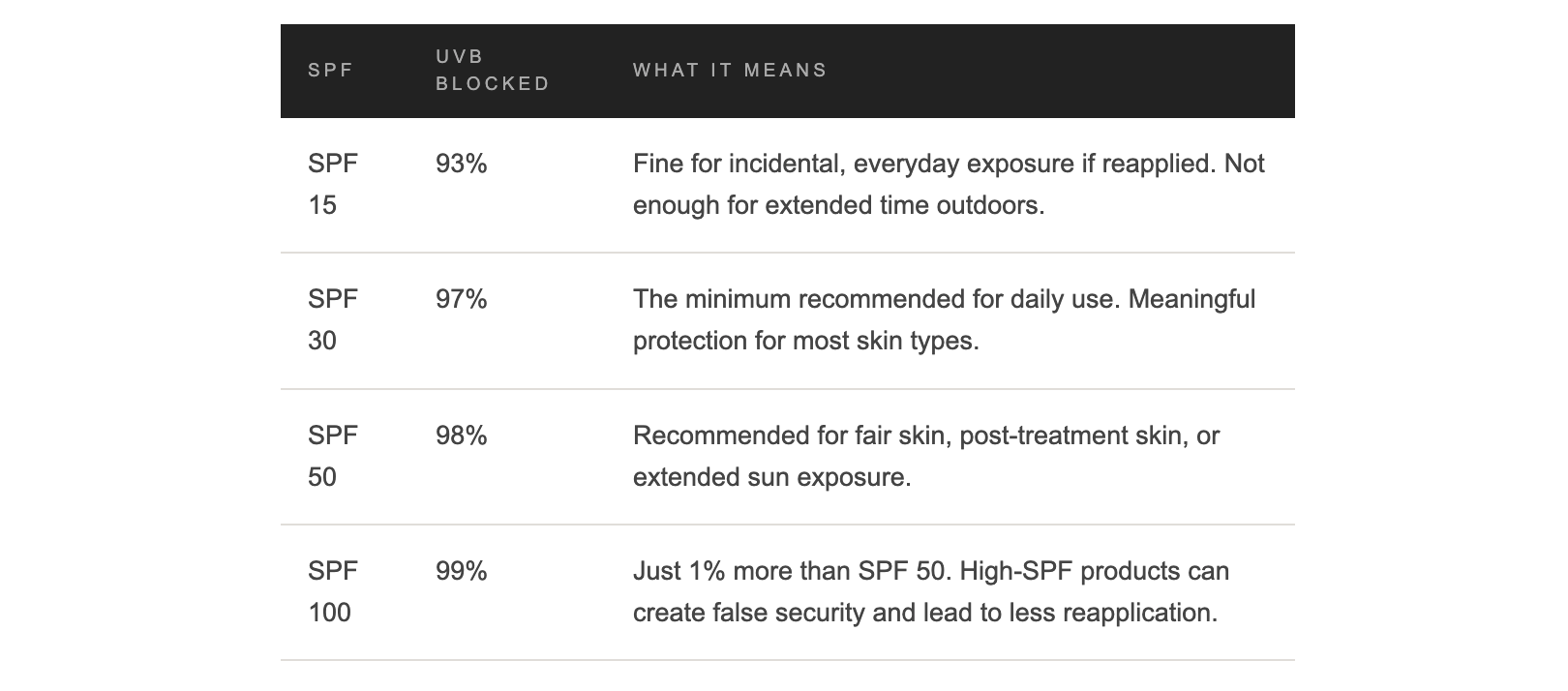
The takeaway: SPF 30–50 broad-spectrum, applied generously and reapplied every two hours in the sun, is the standard that actually protects your skin. Consistency beats the number on the bottle every time.
At the Studio
Three sunscreens I trust and why…
I carry these three Dermalogica options because they cover genuinely different skin needs. Here's how I think about each one.
Mineral · SPF 30 - Invisible Physical Defense
Mineral · Sensitive-skin friendly
My go-to for sensitive skin, redness-prone clients, and anyone who wants the most straightforward protection possible. Pure mineral formula with zinc oxide — no chemical filters, no fragrance, no fuss. It applies like a lightweight fluid and disappears into skin without the chalky finish mineral sunscreens used to be known for. Great under makeup.
Mineral · SPF 40 - Porescreen Mineral Sunscreen SPF 40
Mineral · Makeup-friendly · Pore-blurring
This one earns its place on the shelf because it does two jobs at once. Mineral SPF 30 protection plus a blurring, pore-minimizing primer finish that actually improves how your foundation wears. If you've ever skipped sunscreen because it felt like one too many steps, this is the answer. Silky texture, zero white cast, and skin-smoothing effect that makes it genuinely enjoyable to apply.
Chemical · SPF 50 - Bio-Lumin C Heat Aging Protector
Chemical · SPF 50 · Vitamin C antioxidant
The chemical option in the lineup — and a smart one. It pairs SPF 50 protection with a potent dose of vitamin C, so you're defending against UV damage and actively working to reverse oxidative stress at the same time. The warming sensation on application is the vitamin C activating — completely intentional. Best suited for clients who love the feel of a chemical sunscreen, want antioxidant support built in, and don't have reactive skin.
Thanks for reading!